Made with ApexNo. 03ApexGantt
Of Apollo 11's 195 hours, about two and a quarter were spent exploring the Moon.
Apollo 11 from lift-off on 16 July 1969 to splashdown on 24 July, drawn as a schedule from the mission's records. Each stretch of the flight sits inside the longer one that holds it, down to the time between Neil Armstrong's first step on the Moon and his last. Step through to zoom in.
Apollo 11 flew for 195 hours 18 minutes, and Armstrong spent 2 hours 13 minutes of them out on the surface of the Moon, just over 1% of the flight, against 1 hour 41 minutes for Aldrin. While Eagle was away, Michael Collins, alone in Columbia, spent about 10 hours 50 minutes behind the Moon, out of radio contact with Earth.
- Data
- 1969
- Licence
- Public domain (US government works); Lunar Surface Journal times used as facts, with citation
- Made by
- The ApexCharts team
- Built with
- ApexGantt
How it was made
The piece is one ApexGantt chart of eight rows, each a stretch of the flight. Its three steps frame three windows of it: the whole eight days, the 28 hours Eagle and Columbia spent apart, and the two and a half hours between opening Eagle's hatch and closing it.
Spans inside spans
A schedule usually lists tasks one after another. Here each row sits inside the row it hangs from, and that nesting is the story: the flight holds the time apart, which holds Eagle's stay on the Moon, which holds the moonwalk. Each row names its parent with parentId, and showSummaryBar: false keeps a parent's own dates rather than the span of its children, so "Eagle on the Moon" runs from landing to lift-off, not just around the moonwalk.
Each bar is labelled with its length. The rows carry the label as a field of their own, and barLabel reads it with position: 'auto', so the chart estimates each label's width from its length and sets it inside the bar when it should fit, beside it otherwise:
barLabel: { position: 'auto', field: 'durationLabel' },
A step labels only the bars wholly inside its window, since a longer bar's centred label would show a fragment at the edge.
Fifteen passes, one bar
Collins's row is a single task with fifteen segments, one for each pass behind the Moon while he flew alone. A pass takes both its ends from tracking, the times Mission Control read up to the crew, or both from the Flight Plan, never one of each. The plan ran about two minutes later than tracking, which moves a pass but barely changes its length.
Lines, not regions
The first version marked the three legs of the flight as shaded regions:
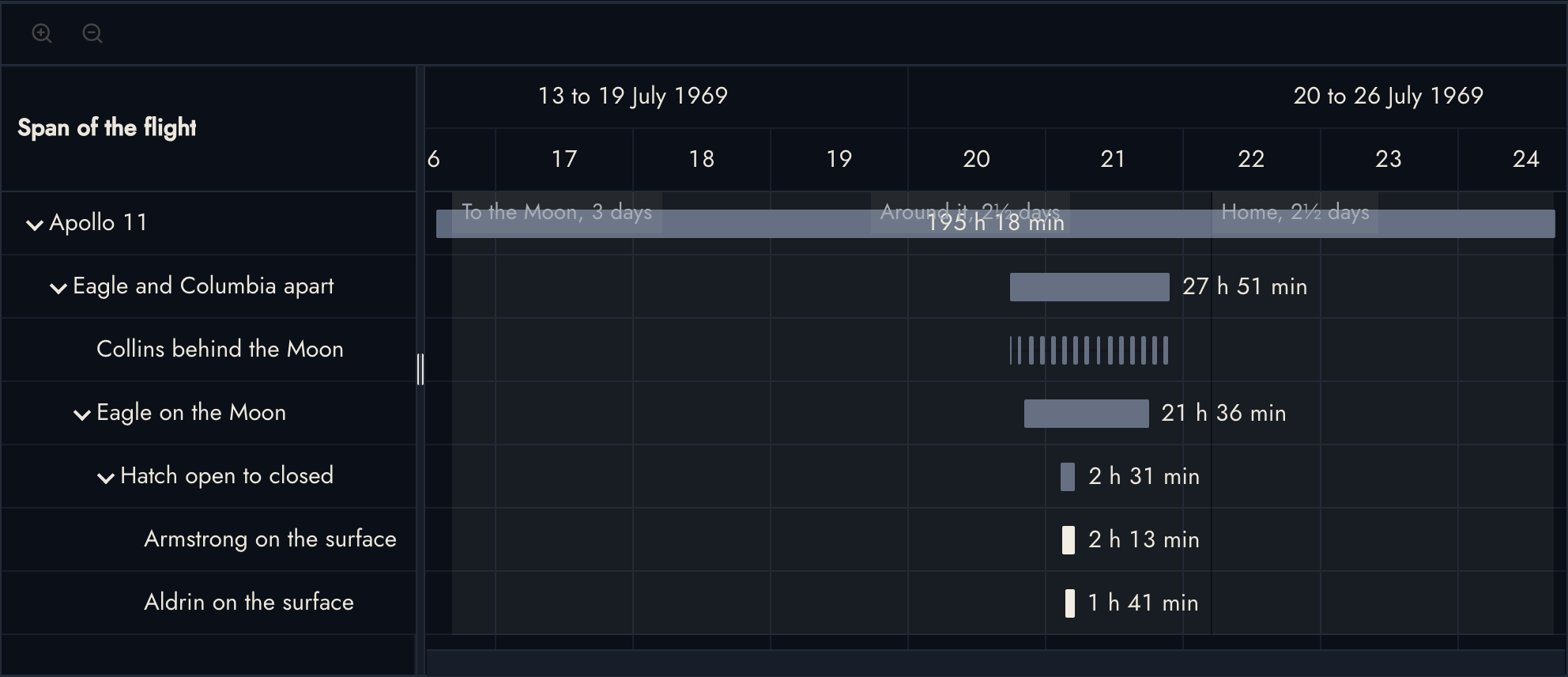
An annotation's label sits at the top of the chart, on the first row, and a region's tint lies over every bar beneath it. So the legs of the flight are line annotations with an opaque tag, and the first row is a lift-off milestone. Once the view moves past launch that row is empty, which gives the tags a lane of their own. The one region left marks the fourteen minutes of the flag and the President's call, too narrow to read as a wash.
The tags come in three sets, chosen by the chart's width, and what a narrower set leaves out is written on a line under the chart.
Every number is computed
The data at the top of the script holds each time as its source prints it, in Ground Elapsed Time, with the source it comes from (for the Mission Report, the table or section); where no source times a moment to the second, it holds the bounds the record allows. Every duration, count and share in the words is worked out from that data, and so is the headline: the piece computes it and reports any difference from the text it shipped with, and the site's build checks this page's headline against the piece's.
What is hand-written
The step buttons, captions and key are ordinary HTML. A step sets the chart's zoom and scroll with setState:
gantt.setState({ zoom }) // pixels per day
const bar = ganttEl.querySelector('.bar-timeline[data-taskid="mission"]') // the Apollo 11 bar
const left = parseFloat(bar.style.left) // where lift-off sits at this zoom
gantt.setState({ scroll: { horizontal: left + ((start - liftoff) * zoom) / DAY, vertical: 0 } })
The time axis begins on a whole hour or day that moves with the zoom, so the piece reads where lift-off sits from the start of the Apollo 11 bar, which begins at lift-off, each time rather than assuming it. Both readings come from the rendered chart, not its API: that bar's inline left, and the width of the timeline's scrolling area (.timeline-body-wrapper), which sets each step's zoom.
The tooltips are a tooltipTemplate that gives both clocks and the source of each time, each bar's spoken label is set through locale.messages to its span, length and times, and the crosshair label reads the mission clock. The header labels are set per tier, so a zoomed-in hour carries its date. On a phone the task list turns narrow and flat, with short names, through one update.
Sources for each time
- Lift-off, undocking, landing, the hatch opening and closing, lunar lift-off, docking and splashdown: the Mission Report, Table 3-I. Armstrong's first step: its section 1. The flag and the President's call: its Table 12-II.
- Armstrong's last moment on the surface, and Aldrin's first and last: the Apollo Lunar Surface Journal, which reconstructs them from the tapes. Aldrin's are known to within half a minute. The Mission Report gives 2 hours 14 minutes and 1 hour 42 minutes on the surface for the two men (p. 12-1); the piece counts whole minutes between times to the second, so each reads a minute shorter.
- Collins's passes behind the Moon: six from tracking, read up in NASA's air-to-ground transcript (one acquisition of signal is the Lunar Surface Journal's), and nine from the Flight Plan.
The Mission Report, the Flight Plan and the transcript are US government works in the public domain. The journals' text belongs to their editors, so the piece takes only times from them, as facts, with citation.
Get the code
The piece is one HTML file with its data inside it, loading ApexGantt from a CDN. Save it and open it in a browser, or take it apart.
ApexGantt needs a licence key: add yours where the file marks the spot. Without one it shows a watermark.